Table of Contents
Quick Answer
Bottom line: This profile helps you evaluate local businesses fast with essential decision data.
Key Facts
- Verification status: editorially reviewed
- Data refresh cycle: ongoing
- Best for: users comparing options quickly
How to Use Google Business Profile in 2026: Complete Setup & Optimization Guide
In the evolving field of local search engine optimization, maintaining a strong online presence is no longer optional for businesses seeking sustainable growth. As we move into 2026, the Google Business Profile (GBP) remains the cornerstone of local visibility and digital credibility. With Google Maps and Search integrating more deeply with AI-driven results and Search Generative Experience (SGE), your profile acts as the primary digital storefront for potential customers. Ignoring this platform means losing significant traffic to competitors who have optimized their listings for both human users and automated algorithms. Voice search adoption has also surged, with many users asking assistants for nearby recommendations rather than typing queries. Recent data suggests that over 40% of voice searches are looking for local business information specifically. This guide provides a comprehensive roadmap for setting up, claiming, and optimizing your profile to dominate local search results in the current digital year, ensuring you capture high-intent traffic effectively.
Understanding the nuances of this platform is essential for any business owner who wants to remain competitive in a rapidly changing digital ecosystem where immediacy and accuracy define success. Furthermore, as privacy regulations tighten, having a verified first-party data source like GBP becomes crucial for maintaining customer trust and ensuring your data is not misinterpreted by third-party aggregators. In 2026, the difference between a complete profile and a sparse one can determine whether you appear in the coveted Local Pack or remain buried on the second page of results. For deeper insights on reputation management, you can explore How to Get More Google Reviews for Local Business. Proper management ensures that your business information is consistent, accurate, and primed for conversion.
To maximize your local search potential, it is vital to stay updated on platform changes and best practices. For broader context on service providers and tools that complement your local strategy, see Best Local Home Service Platforms 2026: How to Find, Vet, & Hire Contractors You Can Trust. Leveraging the right tools alongside a robust profile ensures you are equipped to handle customer inquiries and service delivery efficiently. This holistic approach to local SEO combines technical optimization with customer experience management.
What is Google Business Profile and Why Does it Matter in 2026?
Google Business Profile is a free tool provided by Google that allows business owners to manage how their information appears across Google Search and Google Maps. In 2026, its importance has escalated due to fundamental changes in how users interact with search engines. Modern search behavior relies heavily on the “Local Pack,” the map-based results that appear at the top of search queries. Statistics indicate that over 76% of people who search on their smartphone for something nearby visit a business within a day, and 28% of those searches result in a purchase. These numbers highlight the critical connection between local visibility and revenue. Without a strong presence here, you are effectively invisible to the majority of local customers who are ready to buy. The profile serves as a direct conduit between consumer intent and your physical or service location.
Furthermore, the integration of generative AI into Google Search means that accurate, structured data from your GBP is crucial for AI Overviews to cite your business as a reliable source. Without a verified and detailed profile, your business risks invisibility in these automated summaries. Additionally, features such as direct messaging, booking buttons, and product catalogs within the profile have become standard expectations for consumers. A complete profile builds trust, reduces friction in the customer process, and significantly improves click-through rates compared to listings with missing information. In an era where E-E-A-T (Experience, Expertise, Authoritativeness, and Trustworthiness) is paramount, your GBP serves as a primary trust signal for both Google and your customers. It validates that you are a legitimate entity operating in a specific location, which is vital for avoiding spam filters. As Google continues to prioritize helpful content, a well-maintained profile signals that you are an active, trustworthy participant in the local economy. This is especially true for YMYL (Your Money Your Life) niches where trust is scrutinized heavily by algorithms. Ultimately, your profile is often the first interaction a customer has with your brand, making first impressions critical for long-term retention and brand loyalty. For more on reputation, read the Guide to Getting More Google Reviews 2026: Never Stop.
How to Set Up Your Google Business Profile Step-by-Step?
Setting up your profile correctly from the beginning saves time on corrections later and prevents potential suspensions. The process begins by navigating to the Google Business Profile manager and signing in with a Google account dedicated to your business operations. If your business already exists on Google, you will need to claim it. If not, you will create a new listing. Accuracy is paramount during this phase. You must ensure your Business Name, Address, and Phone Number (NAP) match exactly what is displayed on your website and other directories. Inconsistencies here can confuse search algorithms and lower your ranking potential. Even minor discrepancies, such as using “St” instead of “Street,” can cause issues that persist for months. Consistency across the web reinforces your legitimacy to search engines and helps consolidate your local authority.
Once the basic information is entered, the verification process begins. In 2026, video verification has become the standard method for most businesses, replacing the traditional postcard method for many categories. You will be asked to record a continuous video showing your business location, signage, and equipment to prove legitimacy. Some businesses may also qualify for live call verification or instant verification through Google Search Console. After verification, you must categorize your business correctly. Choosing the primary category is the most influential ranking factor, so select the most specific option available. Follow this by adding secondary categories that describe additional services you offer. Finally, input your operating hours, including special hours for holidays, to prevent customer frustration. For service-area businesses without a storefront, ensure you hide your address and define your service regions clearly to comply with guidelines. Common pitfalls include using PO Boxes, which are generally not accepted, and keyword stuffing in the business name field, which can lead to immediate suspension. Always double-check your pin location on the map to ensure customers can find your physical entrance without difficulty.
To streamline this process, consider the following comprehensive checklist:
- Verify NAP consistency across all online directories and social media platforms.
- Prepare video verification assets in advance, ensuring good lighting and clear signage.
- Select the most specific primary category available to match user intent.
- Define service areas accurately if applicable to avoid guideline violations.
- Avoid prohibited content in business names, such as marketing taglines.
- Ensure your website URL is correct and leads to a mobile-friendly, fast-loading page.
- Add a detailed business description using relevant keywords naturally without stuffing.
- Upload high-resolution logos and cover images immediately to establish brand identity.
- Enable messaging features to facilitate direct customer communication and faster response times.
- Link your social media profiles to enhance credibility and provide additional engagement channels.
What Are the Best Optimization Strategies for Local SEO?
Claiming your profile is only the first step; continuous optimization is required to maintain high rankings. One of the most impactful strategies is managing customer reviews. Encourage satisfied clients to leave feedback and respond to every review, whether positive or negative. Responding shows engagement and helps mitigate the impact of negative feedback. In 2026, Google’s algorithms analyze sentiment and response time, so timely, professional replies are essential. Aim to gather fresh reviews regularly, as recency is a strong ranking signal. Implementing automated email sequences post-purchase can help streamline the collection process significantly. Beyond reviews, utilizing Google Posts is vital for keeping your profile active. Weekly updates about offers, events, or new products signal to Google that your business is operational and relevant. These posts appear directly in Search and Maps results, providing fresh content that can improve engagement rates.
Visual content is another critical ranking factor. Profiles with high-quality photos receive 42% more requests for directions and 35% more click-throughs to their websites than those without. In 2026, video content within the profile is also gaining traction. Upload short clips showcasing your team, your workspace, or your products in action. Additionally, populate the Products and Services sections thoroughly. This structured data helps Google understand exactly what you sell, matching you to more specific queries. Do not overlook the Q&A section. Many business owners ignore this, but anyone can ask questions here. Proactively add common questions and answers yourself to provide immediate value to researchers. This pre-empts customer hesitation and reduces the burden on your support team. Regular audits of your profile information are necessary to ensure nothing has changed or been edited by users incorrectly. Consistency in updates tells Google your business is active and reliable. When adding links to your posts, always use UTM parameters to track traffic sources accurately in your analytics platform.
How Can You Track Performance Using GBP Insights?
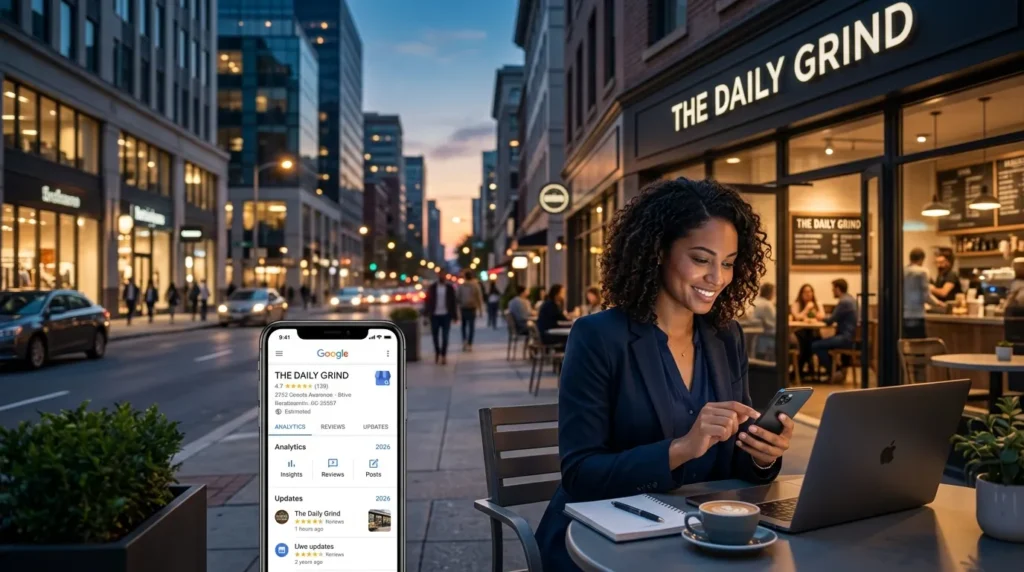
Data-driven decisions are key to long-term success in local search. Google Business Profile Insights provides a dashboard of metrics that reveal how customers find and interact with your listing. In 2026, these insights have become more granular, offering deeper visibility into user behavior. You should monitor “Discovery Searches,” which show how many people found your profile while searching for a category or product, versus “Direct Searches,” where users searched for your specific business name. A high volume of discovery searches indicates strong SEO health. Additionally, track customer actions such as website clicks, direction requests, and phone calls. If you notice a high number of profile views but low action rates, it may indicate that your photos or reviews are not compelling enough to convert interest into visits. Photo views are also tracked; identify which images attract the most attention and replicate that style in future uploads. By reviewing this data monthly, you can adjust your strategy, such as posting more frequently during peak engagement times or updating descriptions to better match search queries.
Frequently Asked Questions About Google Business Profile
Is Google Business Profile really free to use?
Yes, creating and optimizing a Google Business Profile is completely free. Google does not charge for listing your business, posting updates, or responding to reviews. However, be wary of third-party services that claim to charge for verification or basic setup, as these are often unnecessary.
How often should I update my profile?
FAQ
Why trust this information?
Profiles follow a quality checklist and are updated when new verified data is available.
How do I request corrections?
Use the contact page to submit updates with supporting details.
FAQ
Why trust this information?
Profiles follow a quality checklist and are updated when new verified data is available.
How do I request corrections?
Use the contact page to submit updates with supporting details.
Get the Urban Biz Finder digest
Honest reviews and no-hype guides — straight to your inbox. No spam, unsubscribe anytime.
Some links in our articles are affiliate links. See our full Affiliate Disclosure for details.