Table of Contents
Quick Answer
Bottom line: This profile helps you evaluate local businesses fast with essential decision data.
Key Facts
- Verification status: editorially reviewed
- Data refresh cycle: ongoing
- Best for: users comparing options quickly
How to Start a Pressure Washing Business in 2026: Complete Guide
Affiliate disclosure: Some links in this guide are affiliate links. If you click and make a purchase, we may earn a commission at no extra cost to you. We only recommend tools we’d use ourselves.
You can launch a pressure washing business for as little as $500 in startup costs. Most operators reach break-even within 3 to 10 jobs. Few service businesses offer that kind of math.
Pressure washing sits in a rare spot: low equipment cost, high profit margins (45% to 65% on most jobs), and consistent demand in every city and suburb. No contractor license is required in most states. No employees are needed to start. You need a machine, a vehicle, and a plan.
This guide covers startup costs, equipment, licensing, pricing, and how to land your first clients. It also covers what to do when you’re ready to grow.
Why Pressure Washing Is One of the Best Low-Cost Businesses to Start in 2026
A pressure washing business is profitable from the start because input costs are low and demand is local. Chemical costs typically stay under 10% of job revenue. Equipment pays for itself in a handful of jobs.
Demand Is Consistent and Can’t Be Outsourced
Every homeowner with a driveway, deck, or vinyl siding is a potential customer. Commercial property managers need regular maintenance. HOAs contract out seasonal cleaning rounds. This work stays local by definition. It cannot go overseas.
A Solo Operator Can Earn Well Without a Large Team
A single operator can complete 2 to 4 jobs per day at $200 to $500 per residential job. That’s $400 to $2,000 in daily gross revenue from one truck. Many solo operators gross over $80,000 in their first full year of serious operation.
Competition Is Still Thin in Most Markets
In most mid-size cities and suburbs, the competition is fragmented. Yelp listings show a handful of operations, most without a website or consistent reviews. That’s an opening, not a saturated market.
For more low-cost business ideas worth evaluating this year, see our best small business ideas for 2026 guide.

Pressure Washing Business Startup Costs in 2026
You can start a pressure washing business for $500 to $15,000 depending on the equipment tier you choose. Here is how the tiers break down.
Budget Tier: $500 to $2,500
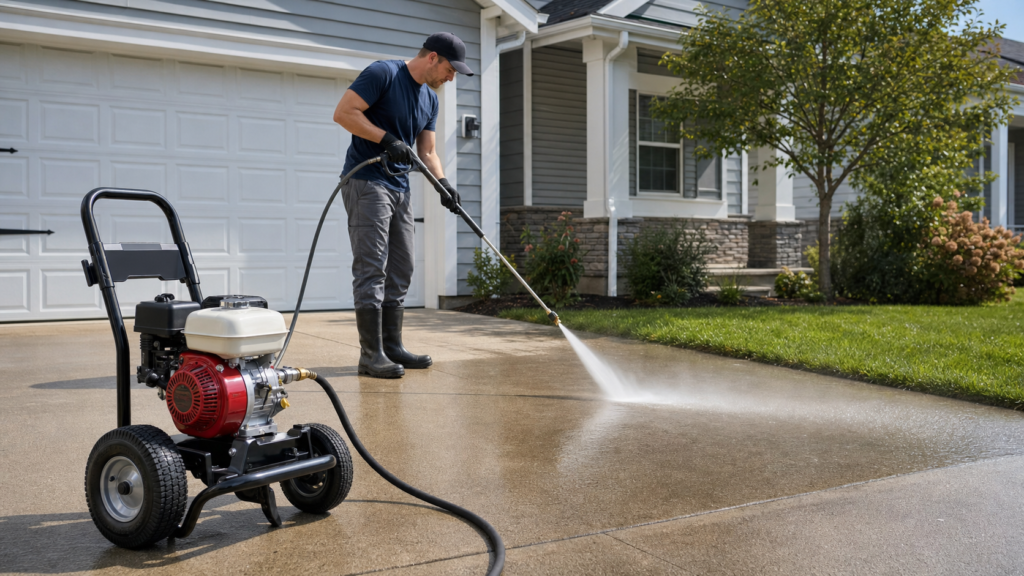
This range gets you a mid-range gas pressure washer (4 GPM, 3,500 to 4,000 PSI), basic nozzles, a surface cleaner for flatwork, a downstream injector, starter chemicals (sodium hypochlorite and surfactant), and safety gear. You use your personal vehicle to haul equipment.
This is the right tier to test the business before committing to larger equipment spend.
Professional Tier: $5,000 to $15,000
This includes a commercial-grade hot water machine, a 250 to 500-gallon water tank for job sites without water access, a soft wash system for roofs and siding, and a trailer. Professional equipment increases daily job capacity and lets you bid on commercial accounts.
Full Commercial Rig: $20,000 to $50,000+
Multi-crew operations with enclosed trailers, multiple machines, and hot water systems fall in this range. You don’t need this to start.
| Startup Tier | Equipment Budget | Best For |
|---|---|---|
| Budget | $500 to $2,500 | Testing the market, first 20 jobs |
| Professional | $5,000 to $15,000 | Full-time operation, commercial accounts |
| Full commercial | $20,000 to $50,000+ | Multi-crew scaling |
Source: ZenBusiness Pressure Washing Startup Costs
What You Can Skip at First
You don’t need a truck wrap, branded shirts, or a CRM subscription to land your first 10 jobs. Spend on equipment. Market through Google Business Profile and your neighborhood. Keep overhead lean until revenue justifies it.
Best Pressure Washing Equipment for Beginners
Your machine is your primary investment. Get this decision right and everything else follows.
Gas vs. Electric Pressure Washer
Gas machines outperform electric for all professional tasks. They deliver higher PSI (pressure) and GPM (flow rate), which determines cleaning speed on concrete and siding. A 4 GPM gas unit is the standard entry point for professional work.
Electric units work for light residential use but lack the flow rate for commercial accounts or full-day operation. If you are serious about the business, buy a gas unit from day one.
Surface Cleaner
A surface cleaner is a disc attachment that spins two nozzles over flat surfaces. It cuts concrete cleaning time by 60% to 70% compared to a wand. Budget $80 to $200 for a solid entry-level model. This single tool pays for itself in the first few jobs.
Downstream Injector and Chemicals
A downstream injector pulls chemical solution from a bucket into your water stream. Sodium hypochlorite (pool shock) is the core chemical for house washing and roof cleaning. A surfactant helps the solution cling to vertical surfaces.
Chemical costs typically stay under 10% of revenue, which is part of why this business carries such strong margins. (source: Lucid Bots)
Safety Gear
Pressure washers at high PSI can cause serious injury. Buy steel-toed boots, chemical-resistant gloves, and eye protection before your first job. This is not optional.
Do You Need a License to Start a Pressure Washing Business?
Most US states do not require a specific contractor’s license for pressure washing. You still need to complete the standard business registration steps.
What You Typically Need
In most states, the minimum setup is:
- A general business license from your county or city (cost: $25 to $150)
- An EIN (Employer Identification Number) from the IRS, applied for free at irs.gov
- A sales tax permit if your state taxes labor or
Related reading: How to Start a Mobile Notary Business in 2026
FAQ
Why trust this information?
Profiles follow a quality checklist and are updated when new verified data is available.
How do I request corrections?
Use the contact page to submit updates with supporting details.
Get the Urban Biz Finder digest
Honest reviews and no-hype guides — straight to your inbox. No spam, unsubscribe anytime.
Some links in our articles are affiliate links. See our full Affiliate Disclosure for details.